

HARDCORE WORSHIP
Reporting from JCHC Fest '26 on the Christian hardcore scene
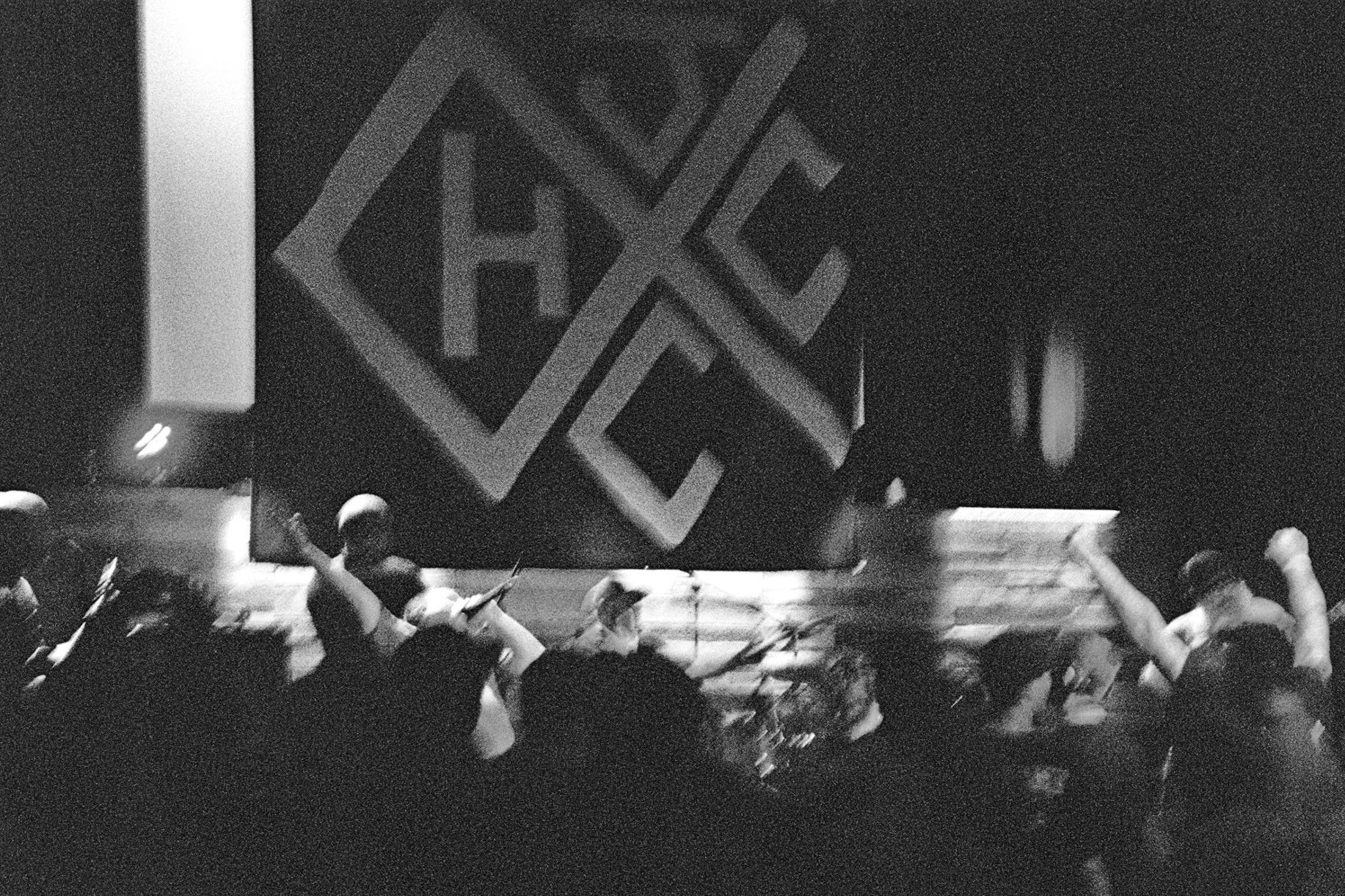
Christian punk, spirit-filled hardcore, and Christcore have all transcended the Church and made fans out of believers and the secular world alike.
My own enthusiasm for heavy Christian music could be described as an anthropological endeavor. I’ve always tried to make sense of how religion fits into the context of genres like metalcore after growing up on the early discographies of Haste The Day, The Devil Wears Prada, and Underoath. While I’m interested in exploring the theology of Christianity, from Orthodox to Protestant interpretations, I’m largely a straightforward music fan with sympathetic tendencies who hasn’t committed to the Church in whole.
But when I hear the songs coming from these genres, it’s abundantly clear that this is an emotional undertaking. I feel something.
That’s why I’m reporting from JCHC Fest ’26 — a Ventura County meeting place for Christian hardcore.
During Officer Negative’s co-headline set at JCHC Fest, the punk stalwarts and their crowd yell “Jesus Christ Hardcore!” in unison. It’s a perfect scene setter, preceded by fellow bands making calls to righteousness and rebuking demonic doctrines, all throughout a day of genre-blending performances. As festivalgoers flock to Ventura Missionary Church with shirts declaring “CHRIST IS KING,” these believers assemble in sweaty communion.
Mulling over why JCHC Fest was founded in the spirit of Officer Negative’s 1997 single “J.C.H.C,” festival organizer and band leader Chad Wiggins boils it down to a simple premise.
“The passion and the desire never went away,” he says. “Now we’re at a time in our life where we don’t need the money. We’re not trying to be rock stars. We can do something creative and fun for Jesus again.”
This is the second consecutive year of JCHC Fest, a milestone not lost on Wiggins or his fellow band member and organizer, Shawn Cothran.
“I’m looking at Shawn’s JCHC tattoo, not knowing when we wrote that song that everywhere we would go in the U.S., we were part of something,” Wiggins says.
Screaming and scripture is a curious pairing, but the combination has origins dating back decades. Bands like Stryper laid the foundation for Christianity to enter the heavy music scene throughout the ‘80s. In subsequent years, the ‘90s spirit-filled hardcore, punk, and metalcore scenes were driven by boundary-breakers ranging from Living Sacrifice to pre-deconstruction Zao. All of these movements coalesced into a broader phenomenon of late-20th-century alternative kin shedding their secular roots.
While punk and metal classically rebelled against dominant institutional structures like religion, Christian youth rebelled against preconceived notions of what punk and metal could be with the support of the evolving, modern Church. Thus, an inverse counterculture was created.
“Christendom was really open to hosting shows. A lot of youth pastors back then saw the work that God was doing, and it gave a lot of young people a safe place to go,” Wiggins recalls. “A lot of kids heard the gospel, and then all those kids wanted to start bands.”
As Christian punks, hardcore kids, and metalheads made a home for themselves in church basements and adjacent auditoriums (where “nobody was getting in fights and people were praying for each other” as recalled by Cothran), mainline listeners and their hyper-defined cliques weren’t necessarily receptive to the guitar-driven gospel. But the inherent unpredictability of breaking Christian heavy music out of youth groups and into the all-encompassing scene wasn’t a serious concern to Cothran as “nobody was exempt from raging at somebody for being different.”
“There’s this recognition that it doesn’t really matter how hard I chase trying to fit in, I can be perfect for this one tiny niche of a scene, and everybody in the other scene is going to reject me, so I might as well be unapologetic about Christ and actually have some peace in my heart,” he adds.
Reflecting on his place within the spirit-filled hardcore movement before he plays to fellow believers at JCHC Fest, Symphony in Peril (and ex-Zao) frontman Shawn Jonas flashes back to “beer bottles [being] thrown at us, telling us to shut up and play.”
Still, those experiences didn’t deter the urgency of his ideals.
“We’re gonna be the same at a secular show as we are at a Christian show. Our message is the same no matter what,” Jonas says.
While artists like Jonas stood firm on their beliefs at risk of whipping up a physical fervor in their early days, Symphony in Peril guitarist Andy Richards highlights the throughline that eventually made it possible for secular hardcore and spirit-filled hardcore to co-exist.
“With underground music in general, people have something they’re standing for,” Richards says. “Whether it is Christianity, or back in the day [when] Hare Krishna was really big, or straight edge, or veganism … I think people appreciate that you have something you’re saying.”
Being comfortable inside and outside of Christian spaces alike, Symphony in Peril have taken the opportunity of stages like today’s JCHC Fest to grapple with the state of the contemporary Church. Sprawling sports-arena services that have nitro-boosted the national megachurch infrastructure are antithetical to the core values of the band.
“The LED screens, the fog, [and] the lighting” have commodified what Jonas calls “the entertainment value of Christianity.” The modern Church is an institution that’s virtually unrecognizable since Symphony in Peril originally disbanded 20 years ago (and is worthy of analysis while playing out new material like “Sheep in Wolves Clothing”).
“We want the pure message of the gospel to be preached — not twisted, not turned. I’m not saying the Church has been perfect by any way, shape, or form. There’s been abuse in [the] Church; there’s been neglect in [the] Church. But at the same time, the real message of Christ [is] the healer, the lover of mankind,” Jonas says. “That’s the message we want to proclaim.”
As the spirited crowd piles on top of Jonas to grab the microphone during standouts from the band’s seminal 2006 record, The Whore’s Trophy, it’s clear that his perspective is shared by a congregation of die-hards on the festival grounds. And in the near future, they can rally around a new Symphony in Peril record called Road to Emmaus that’s deep into the mastering process as of the JCHC pile-on.
Fellow festival headliners Cultist — founded in 2017 — grew up on the Christcore scene that was handed the baton from artists like Jonas. Vocalist Zack Jeffrey points to As Cities Burn and Beloved as early inspirations, while fellow vocalist Jon Davenport found his secular-metal interests transmuted into spiritual heaviness.
”I was into metal music a little bit before I got saved,” he says. “Then one of my homies from youth group put me onto For Today … I started listening to bands like Impending Doom, Those Who Fear, Leaders, [and] it was awesome hearing that you could do that for the Lord.”
Cultist share common threads with bands like For Today who were able to perform for fans from all walks of life, believers or not. But for Davenport, JCHC Fest is a welcome reprieve.
“It’s almost like a recharge,” he says. “These people embolden you with how proudly they’re out there doing it. We’re all experiencing the same hurts [and] the same challenges.”
At JCHC Fest, their brand of earth-trembling beatdown makes it readily apparent as to why they’re rising stars in the revitalized Christcore scene (with the buzz of a brand new album called Saint on the way). Their blend of devastating breakdowns and harmonized screams that communicate poetic lyricism (coming “from a place of healing” according to Jeffrey) is a winning formula.
And while there’s charming mid-set banter from the vocalists that balances out the gravity of their work, they perform pulverizing songs from their acclaimed “Preacher” series “about people who take the word of God and bend it to fit their agenda.”
It’s a mission statement that complements the work being done by fellow artists like Symphony in Peril, especially as Jeffrey reflects on congregations that are “less about the Word [and] so much more about the production.”
To him, waking up with no plans and walking across the street to a church where he was greeted by a pastor in a Seattle Seahawks t-shirt is what faith is all about.
“He’s not there putting on a show. He’s just giving you the Word.”
While speaking with Cothran about the premise of uniting bands like Cultist and Symphony In Peril on the same bill, it’s obvious this is a fulfilling endeavor of faith, but one he avoids taking credit for.
“There’s nothing special about us,” he says. “We’re just doing the work [and] we’re like, ‘Dang! These dudes are on fire for the Lord.’ They’re telling people how much Jesus loves them, and the message is the same.”
It ultimately makes sense why Cothran and Wiggins were inspired to channel JCHC as a concept into JCHC Fest. It’s a day of celebration, while spearheading a serious ontological endeavor with eyes on eternity. And it’s a day made possible after years of operating within the secular landscape.
“Even when we were playing secular shows or not fitting into the world, we always had our brothers and sisters in Christ,” Wiggins says. “That felt really special. So I’m very thankful for JCHC.”